Five storeys above the drop zone: the Jurong Port formwork collapse

01What happened
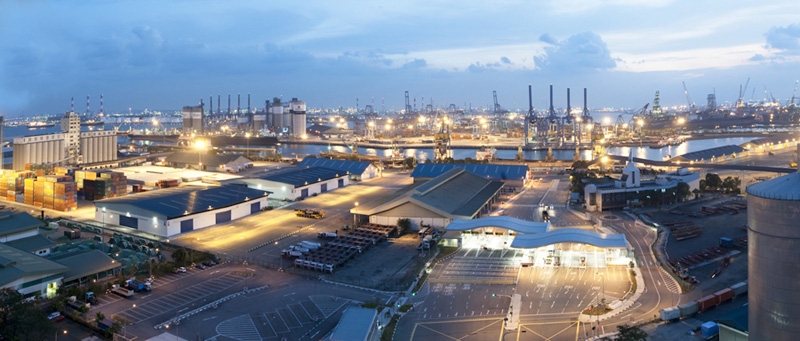
At about 9:50 a.m. on August 3, 2026, at a construction site at 30 Jurong Port Road, a formwork structure fell from the fifth storey of a building under construction while it was being repositioned. It struck a lorry parked below. A 23-year-old worker employed by Keehans Pte Ltd was trapped in the driver's seat.
SCDF's Disaster Assistance and Rescue Team worked with site personnel to lift the collapsed structure off the vehicle and free him with hydraulic rescue equipment. He did not survive. Police stated preliminary investigations did not indicate foul play, and the Ministry of Manpower ordered main contractor HPC Builders to stop all formwork operations at the site — a five-storey prefabrication hub scheduled for completion in 2027 — while the cause is investigated.
02The pattern behind the incident
MOM's preliminary account contains the whole hazard in one sentence: a heavy temporary structure was being repositioned at height, and a person was below it. Repositioning formwork is a routine lifting operation with well-understood controls — rigging inspection before the lift, verification that the load path is secure, and above all an exclusion zone that keeps every person and occupied vehicle out of the area where the load could fall.
Singapore's WSH statistics give the incident context: collapse or failure of structures and equipment ranks among the top three causes of workplace deaths, and 2026's fatality count was already ahead of the previous year's when this incident occurred. Drop-zone incidents recur across the industry for a simple reason — the controls are procedural, the site is dynamic, and the moment a lorry pulls in under an active lift is exactly the moment no one happens to be looking.
03The inspection gap
Pre-lift checks and exclusion zones share a weakness with every other procedural control: they exist in the moments before the work, evaporate under schedule pressure, and leave no trace either way. Was the rigging inspected before this reposition? Was the zone below barricaded and swept? Did anyone re-check it when the lorry arrived? On paper, all of those answers default to yes. In the field, the answers change minute to minute — and the record doesn't.
How SureSight closes this gap
SureSight is built for exactly this kind of short-lived, high-consequence check: observable steps, done at the workface, that today leave no evidence behind.
Verified pre-lift inspection. Before a formwork panel moves, the rigger's or supervisor's glasses capture the checks as they happen — connections, rigging condition, load path — and computer vision confirms each observable step, producing a timestamped record that this specific lift was cleared. No verified pre-lift record, no ambiguity later about whether the check occurred.
The drop zone, watched continuously. An exclusion zone is only real while it's empty. Through the first-person view of the lifting supervisor — or a fixed vantage during the operation — SureSight flags a person or vehicle entering the zone during the lift, when human attention is on the load. The lorry pulling in below is the event the system exists to catch.
Faster answers when the regulator calls. After an incident, a stop-work order stands until the contractor can show its controls are sound. A contractor running verified lift checks can hand MOM an objective record of how every prior lift was conducted — shortening investigations, and demonstrating a working safety system rather than asserting one.
Sources & further reading
- Mothership — Man, 23, dies after scaffolding collapses onto lorry at Jurong construction site
- AsiaOne — Man dies after being trapped in lorry by collapsed scaffolding at Jurong Port site
- Splash 247 — Worker killed in Jurong Port construction accident
- The Online Citizen — Worker, 23, dies after scaffolding collapse at Jurong Port construction site